
Announcement Compilation
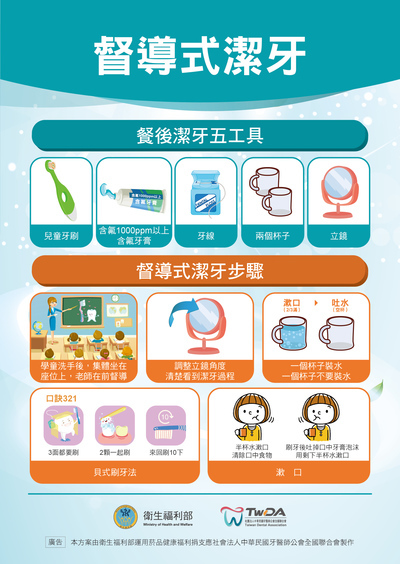
113 Academic Year Freshman Orientation: Dental Hygiene Notice. Freshmen must bring their dental hygiene tools and perform oral hygiene maintenance after lunch (12:15 PM - 12:20 PM) to keep their teeth healthy.
{{ $t('FEZ002') }} Student Affairs Office|
New students must bring a toothbrush, toothpaste or mouthwash (with fluoride), dental floss, or interdental brush to school, and brush their teeth after lunch (12:15-12:20).
Correct Brushing Technique (Reprinted from the Hospital of China Medical University)
2024/3/22
Brushing primarily cleans the areas of the teeth near the gums and the chewing surfaces. When brushing, you must include a bit of the gum line, brushing into the gingival sulcus, which will be more beneficial for maintaining periodontal health.
How to Use a Toothbrush?
I. Brushing Sequence:
Brush in the same sequence to avoid missing any areas, for example:
- Brush the lower teeth first, then the upper teeth;
- Brush the back teeth first, then the front teeth;
- Brush the inner surfaces of the teeth first, then the outer surfaces.
II. Brushing Method: The best brushing method may vary for each person; you can practice as recommended by your dentist. Choose a toothbrush with medium or soft bristles and a smaller head, and use gentle pressure. Common brushing methods and their suitability are as follows:
(I) Modified Bass Technique: Suitable for healthy gums or most cases of periodontal disease
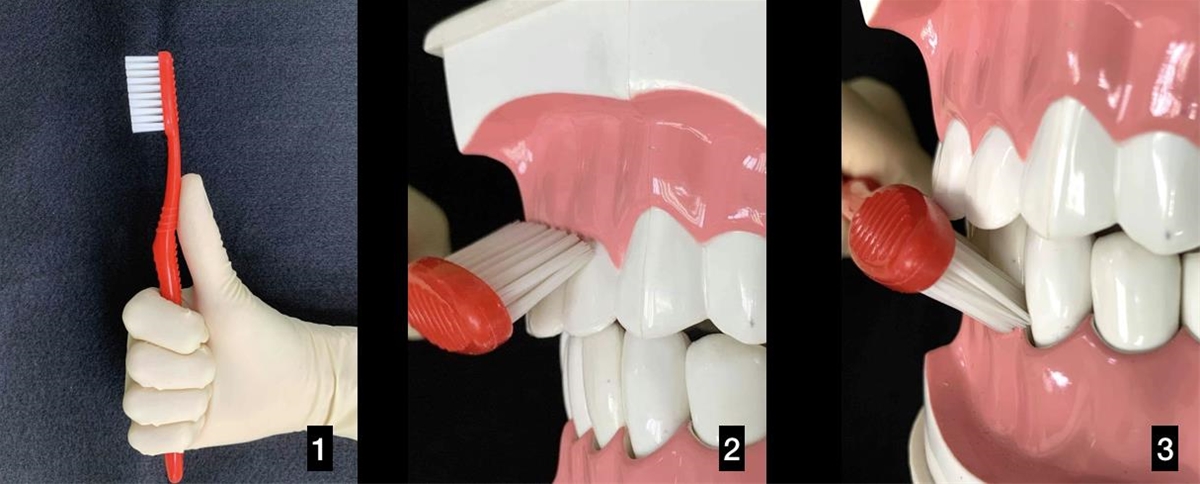
- Grip the toothbrush as shown in (Figure 1).
- Place the bristles at the junction of the tooth and gum, angling the bristles at 45 degrees.
- Upper Jaw: Angle the bristles upwards at 45 degrees (Figure 2).
- Lower Jaw: Angle the bristles downwards at 45 degrees (Figure 3).
- Once the toothbrush is in position, begin short, horizontal (back-and-forth) strokes, brushing two teeth at a time, about 10 strokes per area, and finally, rotate towards the chewing surface for the last few strokes.
- Inner surfaces of front teeth: Hold the toothbrush vertically and brush up and down along the gum line.
(II) Localized Special Brushing Technique: Suitable for receding gums or 2-4 weeks after periodontal surgery
- Soft bristles.
- Angle the bristles towards the gum line, keeping them close to the gums.
- Gently vibrate the brush towards the chewing surface of the teeth.
How to Use Interdental Brushes and Single-Tuft Brushes?
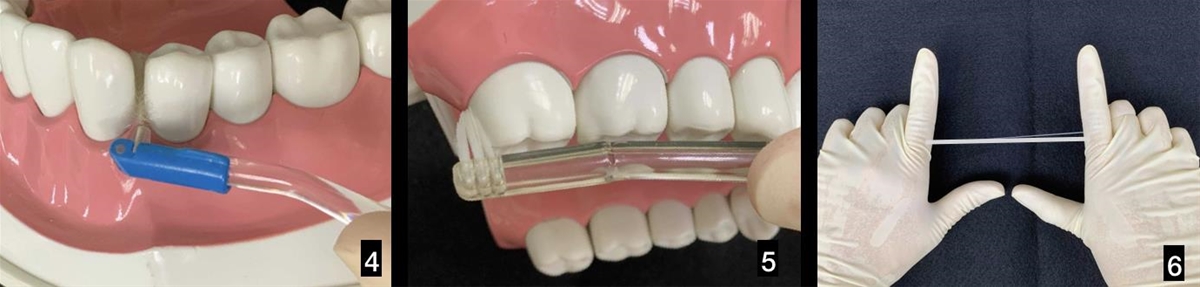
- Suitable for most patients with periodontal disease. Choose an appropriately sizedinterdental brush, with the selection criterion beingthe largest size that can easily fit into the gap between teeth. Dip the interdental brush inplain water, insert it into the gap between teeth, and gently clean back and forth about 5 times, brushing lightly along the root surface (Figure 4). For the back teeth, you can bend the bristles and handle to an almost 90-degree angle (L-shape) or purchase an angled interdental brush.
- For limited space in the back molar area, a single-tuft brush can be used to enhance cleaning of the molars (Figure 5).
How to Use Dental Floss?
Suitable for all tooth gaps. Choose regular floss, tri-floss, or floss threaders as needed. If you have difficulty with hand dexterity, consider using floss picks or a water flosser.
- Take a piece of floss about the length of your arm, wrap the ends around your middle fingers, leaving a gap between your hands (Figure 6).
- Place your fingers inside and outside the mouth, and gently slide the floss into the gingival sulcus between two teeth at a diagonal angle.
- Tighten the floss and scrape upwards along the tooth surface, cleaning both sides of the tooth.
- When cleaning the next gap, loosen one loop of floss from one finger and wrap it around the other finger. Repeat this process until all tooth surfaces are cleaned.
References
- Lindhe's Clinical Periodontology and Implant Dentistry 7e
- Newman and Carranza's Clinical Periodontology 13e
{{ $t('FEZ012') }}
{{ $t('FEZ003') }} Invalid date
{{ $t('FEZ014') }} Invalid date|
{{ $t('FEZ004') }} 2024-07-15|
{{ $t('FEZ005') }} 1467|